
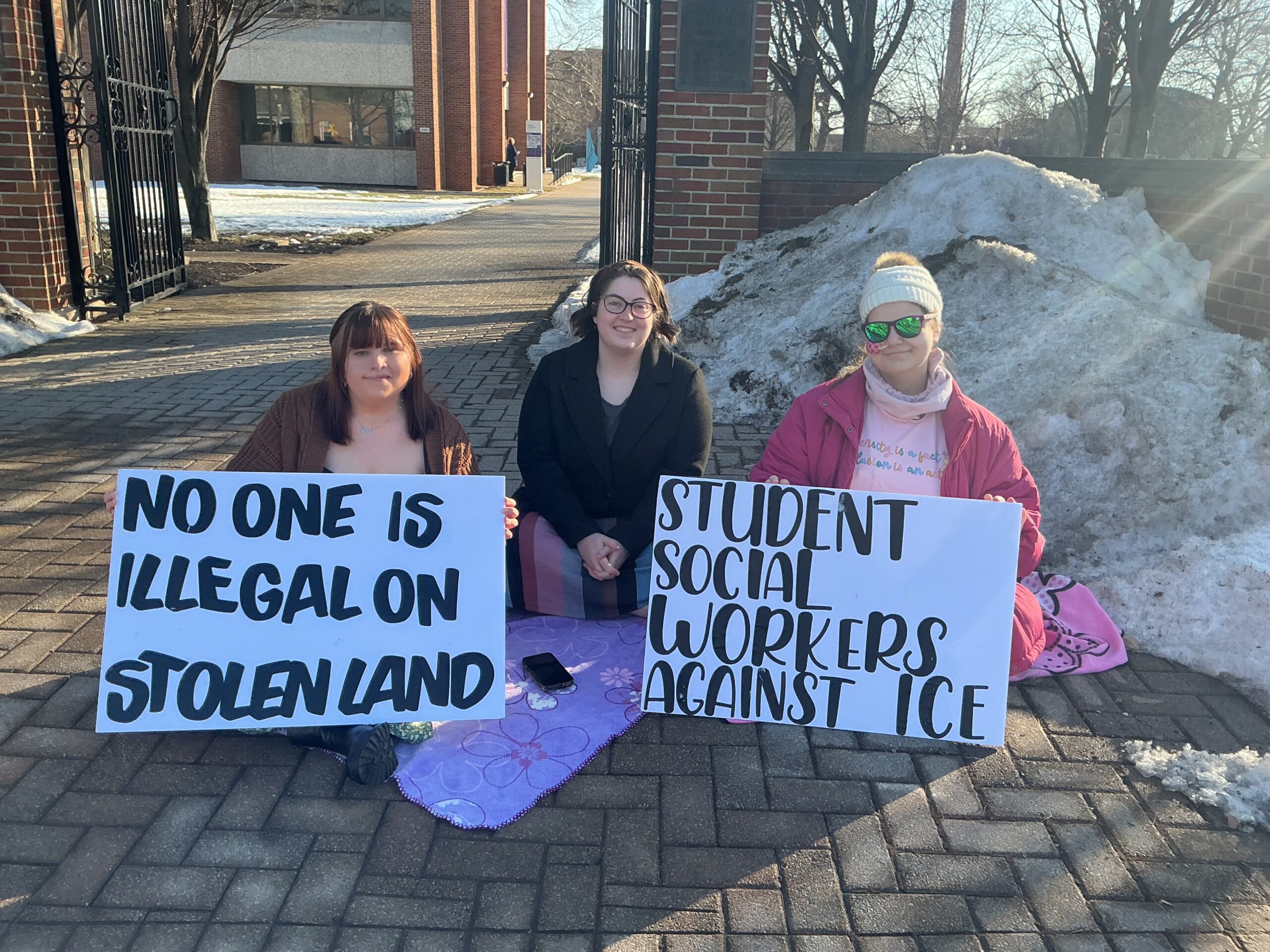
About a dozen students gathered outside the Memorial Gateway on Feb. 13 to protest once again against Immigration and Customs Enforcement (ICE). Although the scene was one familiar to the university following the larger student protest on Jan. 23, things were slightly different.
This protest was not anonymously organized; the demonstration was organized by Dez Dunn, a senior student.
“I thought the first protest was really great, but I don’t think doing a one-and-off protest is really going to do much. I think it needs to be a consistent thing,” said Dunn, who wasn’t able to be at the last protest because he was student teaching.
The first protest was organized by a group of students in a completely anonymous group chat. Even Dunn wasn’t sure who exactly had put together the first protest.
Using anonymity can hurt or harm a cause. In these protests, many students worried about being identified for fear of their safety; however, anonymity also creates issues when verifying basic information someone is saying. If someone can say anything when they are anonymous with no repercussions, their information isn’t very trustworthy. Being anonymous can also create the impression that someone is afraid to be identified with their own views.
Anonymity within the first protest led to confusion and rumors about who actually had organized it, but students did have good reasons for remaining anonymous.
“We know that ICE and other law enforcement agencies use facial recognition software. We know that they are creating a database of people who appear at protests. If we’re realistic, we know that the current government in the United States at the national level is not as committed to protecting the rights of U.S. citizens as historically U.S. governments have been,” said Kevin Lucas, an associate professor of political science at the university. “It’s completely reasonable why you would want to hide your identity for any sort of opposition political involvement.”
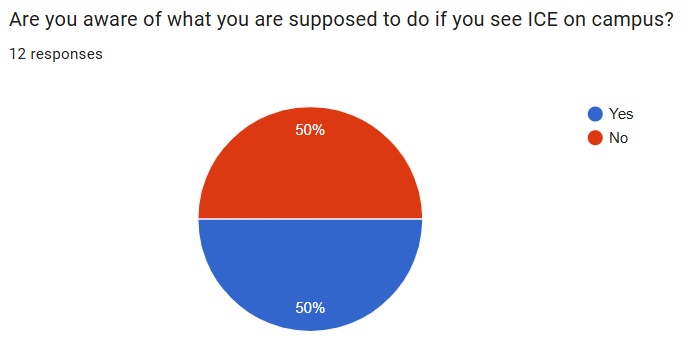
Even after President Tice gave a statement to the Chimes explaining campus policy regarding ICE, much of the student body remains uninformed as to what they are supposed to do if ICE were to come to campus. A survey conducted by the Chimes showed that only 50% of respondents are aware of university policy. Even students who were attending the second protest were mostly unaware of university policy.
“People … even if they’re at the protest against ICE activity here on campus, for community-based reasons … recognize realistically [that] the policies of some tiny little college … isn’t going to stop [ICE],” Lucas continued. “We’ve seen ICE, and their activities have ignored all sorts of these distinctions, so, while it’s good to have a policy as a university, there’s no reason to expect that if ICE were to descend upon campus, they would care at all about what [the university’s] policies are.”
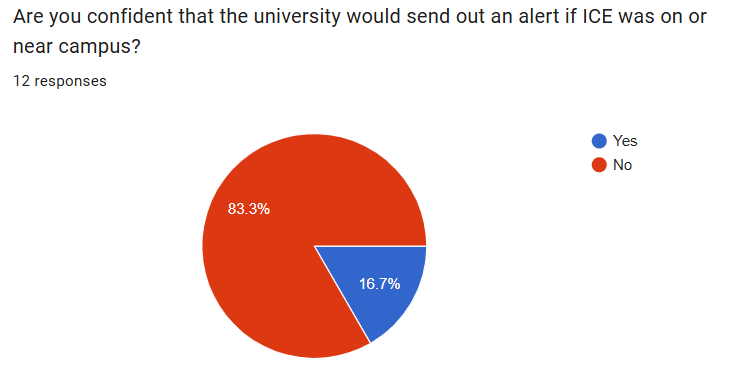
Even with the policy, respondents remain unconfident that the university would inform students, faculty, and staff if ICE were on or near campus, with 83.3% of respondents saying that they are not confident that the university would send out an alert.
Almost half of respondents, however, answered “neutral” when asked about how likely they find it that ICE would come to campus. A quarter of respondents answered that they find it unlikely, and 16.7% answered that they find it highly unlikely. A larger survey would have to be done to get a clear reading of students’ attitudes, but these results give a rough estimate.
There are immigrant students and international students at the university, but their numbers are pretty small.
“Currently, international students studying at [the university]l on non-immigrant visas and students with immigrant status represent 3-4% of the total student population. In fall 2025, enrollment of new international students increased significantly,” explained Maria del Mar Aponte, the director of the university’s Center for Global Education.
If university policy isn’t relevant to protesting students, and immigrant and international student numbers are small here, it puts into question the point of protesting on campus at all.
“One reason would be to try to raise awareness in your local community,” Lucas said. “This is your community for four years. If you’re concerned about raising awareness in your community, protesting at the community level as opposed to going downtown … may be a more effective way of trying to raise awareness.”
Protesting — even when you are unaffected by an issue — can also show solidarity for people who are affected.
“Protesting on campus is a way for people who are opposing ICE to demonstrate to students here at [the university] who may be immigrants themselves or children of immigrants, or just people who are non-white and may be more likely to be harassed by ICE, to show support for them locally — to show that there are people here on campus who care about your well-being,” Lucas continued.
Protesting can also simply be a way to get together as a group and do something you enjoy.
“One thing we talk about in my discipline is the notion of political efficacy, the idea that I individually believe that I have the capacity to contribute to change and that my opinions matter,” Lucas explained. “The experience … of feeling joy as you are surrounded by people who have been brought together by a similar political idea … That leads to increases in people’s political efficacy.”
There are still arguments to be made about campus protests being “performative” or “ineffective.” At the end of the day, it’s not about the size of the protest.
Dunn argues that consistency is more important.
“Just [protesting] once — it doesn’t feel like there’s a point to it. You have to be consistent with it,” Dunn said. “Whoever did organize [the last protest] — at least they attempted to do something; they’re doing better than a lot of people.”
