

Val Kilmer, who was struggling with medical treatments at the time of his passing last April following his throat cancer diagnosis in 2015, was cast in “As Deep as the Grave” almost six years ago. Since he was too sick to ever make it to set, Director Coerte Voorhees used generative artificial intelligence (AI)tools to bring his vision of Kilmer’s role back to life.

Posthumous acting roles aren’t a new idea, with a recent mainstream example being Paul Walker’s appearance in “Fast X.” A combination of computer generated imagery (CGI) and archival footage from “Fast Five,” another movie in the “Fast & Furious” series, was used to pay tribute to Walker and his character in the movies.
The difference between this use of CGI and Kilmer’s resurrection is that Kilmer never actually appeared on set.
Kilmer passed away from pneumonia on April 1, 2025, and due to medical complications, couldn’t show up to any of his scenes in “As Deep as the Grave.” Voorhees said the film “was very much designed around him,” and according to Voorhees, Kilmer’s family and estate expressed how important the film was to Kilmer.
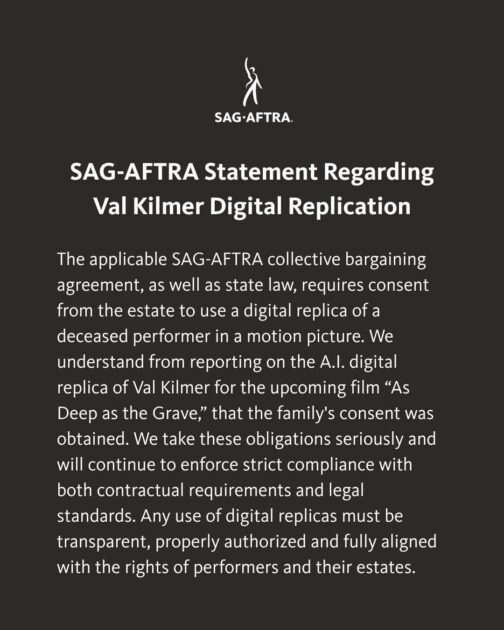
According to a statement from SAG-AFTRA, consent from Kilmer’s family was obtained to artificially generate all scenes showing the late actor. In other words, this is a legal portrayal of Kilmer’s likeness; however, the public is less open to this idea of an artificial resurrection. Voorhees knew that this decision would come with controversy but wants “As Deep as the Grave” to set a precedent for ethical AI use in films.
This isn’t the first time Kilmer has been involved in an AI-related project. Following Kilmer’s treatment for throat cancer, his voice was left broken and raspy. After the release of a documentary about Kilmer’s health struggles, “Val,” an AI voice platform, Sonantic, set out to digitally recreate Kilmer’s voice for future endeavors. Similar to Walker, Kilmer’s voice was digitally revived using old audio of him speaking pre-cancer treatment.
Kilmer later said in a statement, “[T]he ability to communicate is the core of our existence and the effects from throat cancer have made it difficult for others to understand me. The chance to tell my story, in a voice that feels authentic and familiar, is an incredibly special gift.”
After which, Kilmer pleaded to the producers of the then in-production film, “Top Gun: Maverick,” to recast him in the film to reprise his role from the original – further supporting the thought that Kilmer kept wanting to express himself in film, despite his health complications.
The production of “As Deep as the Grave” has been prolonged by the COVID-19 pandemic and the troubles that arise from being an indie production. The budget once became such an issue that scenes involving Kilmer’s character, Father Fintan, were going to be cut; however, Voorhees later decided the scenes were vital to the narrative. “Normally we would just recast an actor,” Voorhees said, “but we can’t roll [the] camera again. We don’t have the budget. We’re not a big studio film. So we had to think of innovative ways to do it. And we realized the technology is there for us.”
The debate on whether to use AI, CGI, or any sort of digital resurrections is one with no end in sight. With the addition of loosely regulated and frighteningly new technology, such as generative AI, viewers are left to come up with their own opinions on Kilmer’s revival, only adding further complications to the dilemma.
The film is expected to be released in 2026.