

Due to artificial intelligence’s (AI) elevating role in society, students are becoming more comfortable cheating on assignments; however, teachers are also using generative AI to create and grade their assignments.
The Chimes spoke with Ohio high school teachers to find they often use AI in ways that support themselves, as well as the student. Teachers argue they can decide effectively whether any specific use of AI would lessen the success of the assignment because of the experience the teacher has.
English teacher at Westfall High School, Daniel English, “will use [AI] to brainstorm certain things,” but not to completely replace the conventional teaching strategies many educators use.
While teachers will use AI to brainstorm, oftentimes they find ChatGPT or Google Gemini to provide lackluster suggestions.
“I don’t follow [AI suggestions] hardly at all … but it did give me stuff to look for,” said English.
At the university level, students have voiced their concerns about the ethics of their professors using AI to grade or even generate their assignments.
“It’s frustrating when some professors want you to use AI, then others assume you’re using AI, and then some are just using it themselves … ] you don’t know what’s expected of you,” said Willow Crosson-Bush, a first-year student at the university.
Teachers addressed these concerns with both supporting and opposing views.
“I don’t want to say it’s not ethical to grade using AI, especially if you go back and check how they graded it … I could see, though, a student making an argument that it is
not ethical,” said English.
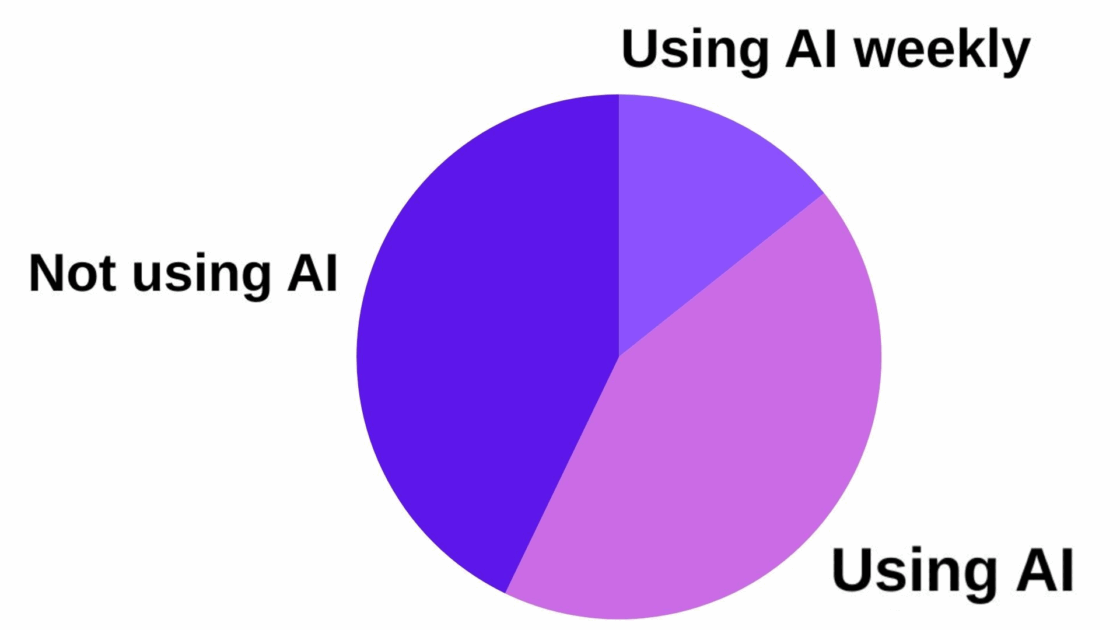
According to Gallup, six in 10 teachers said they had used an AI tool for their work in the 2024-25 school year, with 32% of those teachers using AI on a weekly basis.
“I think it’s completely fine to create assignments [with AI], as long as the teacher proofreads it, just because all teachers do 99.9% of the time,” said Matthew Greenlee, a high school science teacher. “If a teacher creates an assignment themselves, it’s just hodgepodge from previous teachers work.”
With AI being so prevalent in student life, it is not a surprise that teachers are becoming more accepting of this new technology .
Additionally, some students feel their work may be invalidated or underappreciated with more AI in the classroom.
“I think there needs to be a good balance of teaching the ethical side of it and understanding how it works and not being left behind, but then also promoting individual thought,” said Greenlee.
Even when considering both sides of the issue, AI having such a large role in the first place raises questions.
“[I]f you don’t do the human work, you’re not getting the human experience, which is what I think education should prepare you for,” said English. “I think we’re pushing this idea that [education] is all practical, [and] it all has to be based on jobs because the only way to earn respect is your paycheck. I think that is really, really wrong, and … really, really selfish,” said English.
Regardless of their stance on the subject, teachers and students will eventually be forced to accept that AI is only going to get more integrated into their classroom, life and society.
As dystopian as it may feel at times, the world is becoming more “artificially” intelligent.