
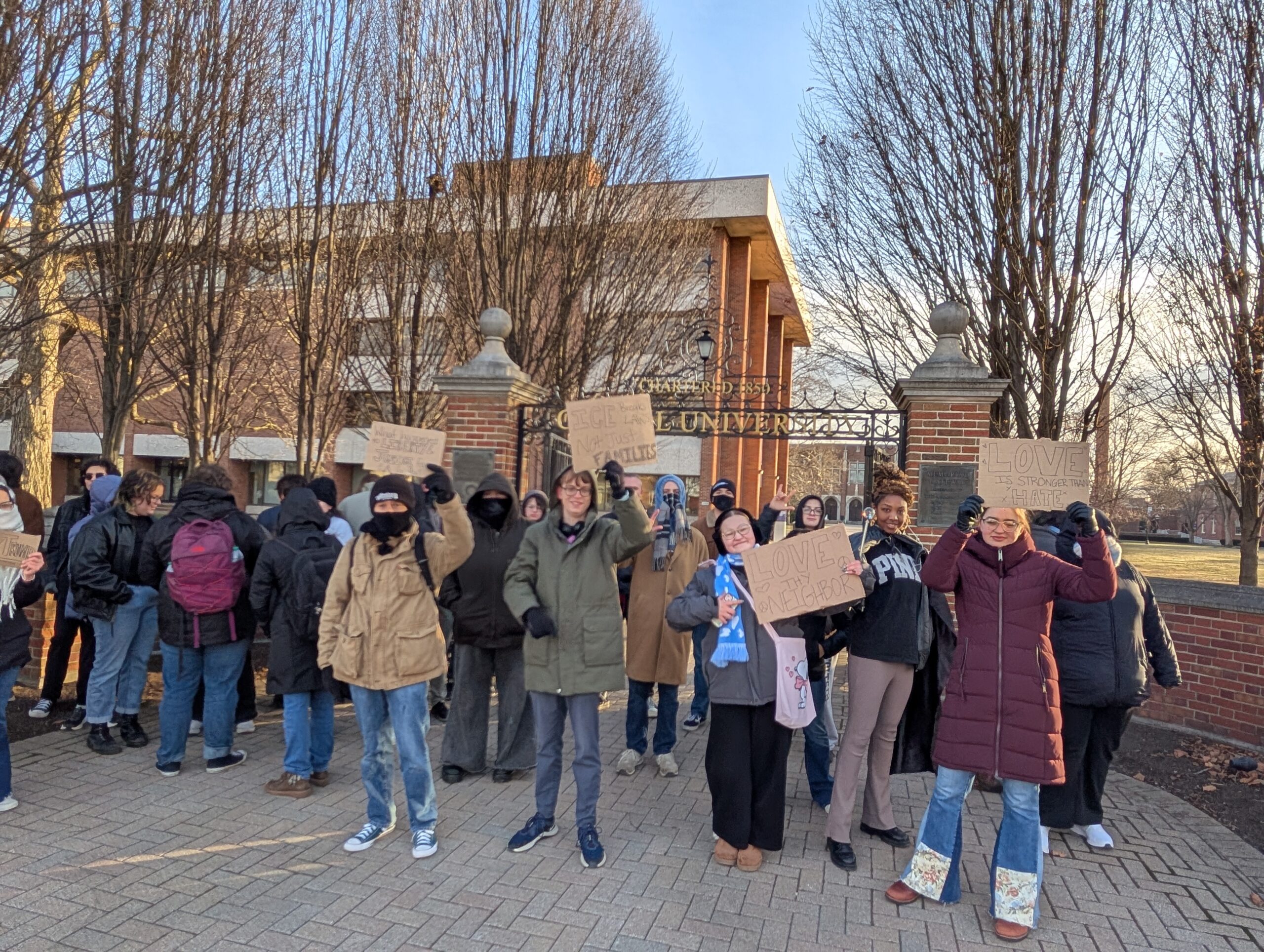
Last Friday, about 35 students gathered outside the university’s Memorial Gateway on East Main Street to protest the recent U.S. Immigration and Customs Enforcement (ICE) presence in Columbus.
According to The New York Times, in December, ICE “highlighted the arrests of 10 men in Ohio as part of ‘Operation Buckeye,’ saying they had criminal records and were in the country illegally.” Columbus Mayor Andrew J. Ginther has called ICE’s presence “unwelcome.”
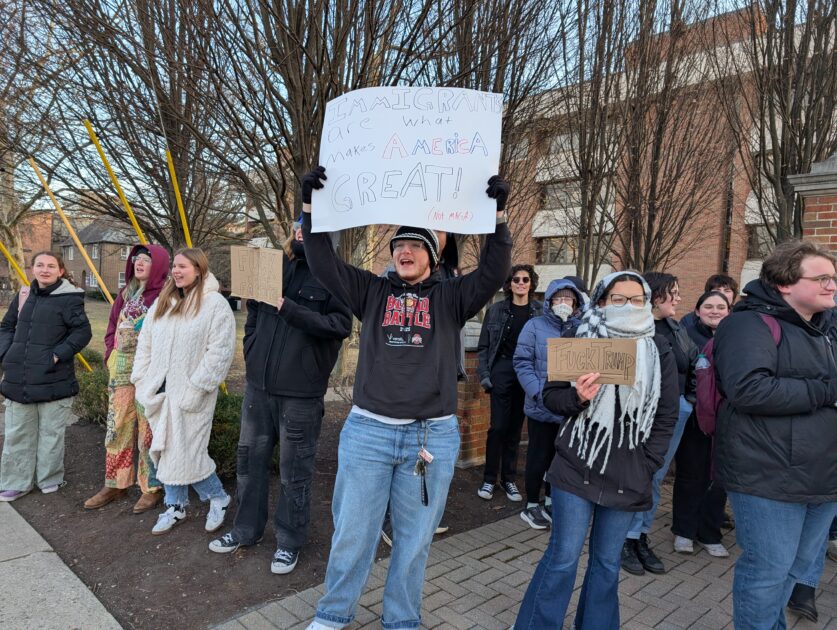
ICE’s presence is certainly unwelcome amongst the university students who protested outside for an hour, despite the below-freezing temperatures. No individual student has taken credit for organizing the protest, as it was announced by an anonymous user on YikYak, a proximity-based social media platform, that there would be a “Capital ANTI [ICE] protest in front of the [C]ap [C]enter Friday 4 – 5.”
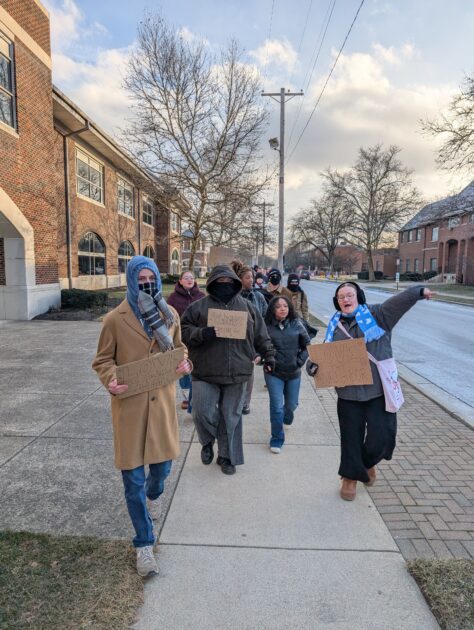
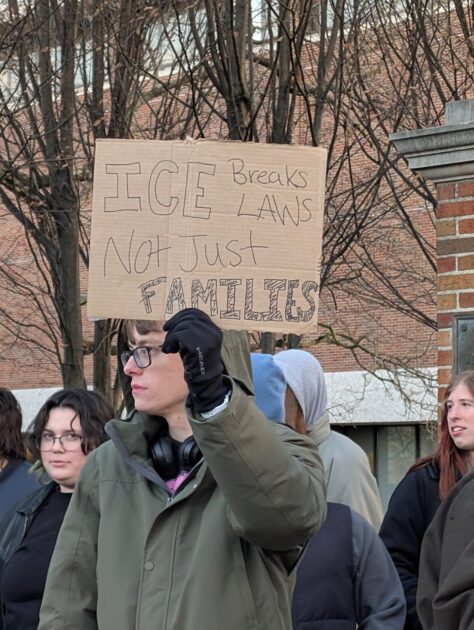
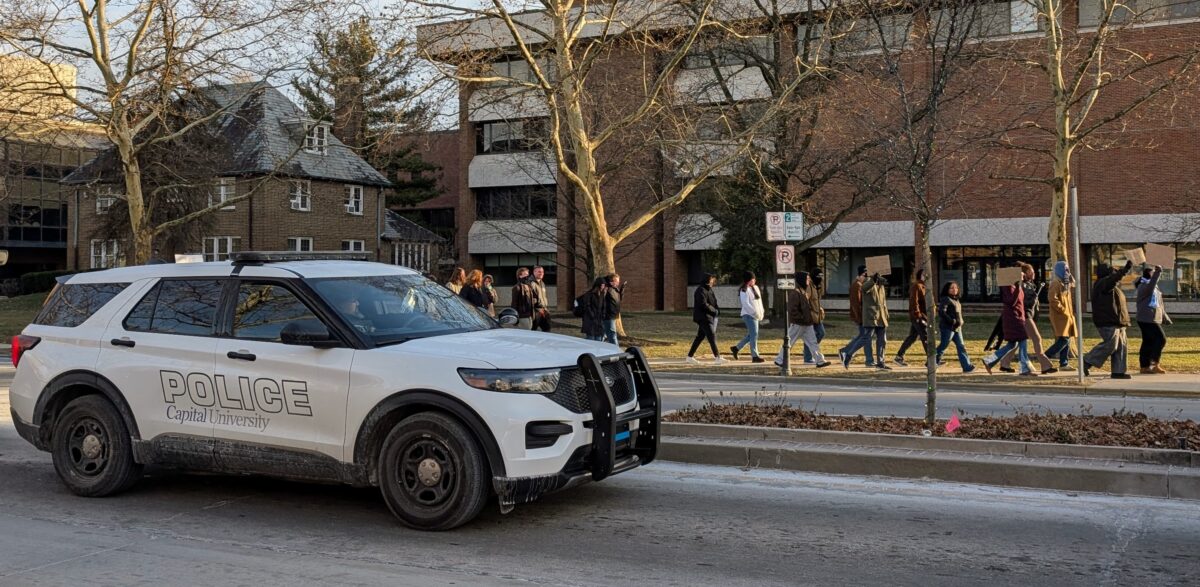
Students started gathering inside the Capital Center right at 4 p.m., dressed in scarves, masks, and sunglasses both for their outdoor function, as well as their ability to obscure their identities. Campus police were already parked across the street at the Alumni House, monitoring the scene. Anti-ICE signs were made on eCampus textbook boxes.
Asked about her motivations for protesting, university student Aubrey Abel stated, “I just think what this current administration’s doing is the most wrong that it could be. I hate it. It’s horrible. They’re tearing families apart…and I think it’s our duty, our civic duty to protest this — frankly fascist — government.”
A counter-protest in support of ICE was also organized on YikYak, but according to Austin Scott, a student employee working the Capital Center front desk during the hour of the protest, no counter-protestors showed up. “I didn’t [see any counter-protestors]. I did see some of the stuff on YikYak.” No counter-protesters could be directly reached for comment, and the original counter-protest announcement has allegedly been removed from YikYak.
A little after 4 p.m., the anti-ICE protesters marched to the Memorial Gateway, where they chanted and cars honked in support.
Many students chose to be interviewed anonymously, or to only give their first names, as they were afraid to be targeted for their views or to reveal last names they share with immigrant family members.
Jackson W. stated, “I feel the counter-protest was more of a fear tactic than anything to try to dissuade people from showing up because, honestly, I have not seen any real push back to this.” Jackson chose not to share his full last name to protect the identity of immigrant family members.
Chants and impromptu speeches continued throughout the hour. Chants included “O-H, ICE out!”, “No Trump! No KKK, no fascist USA!”, and “What do we want? Justice! When do we want it? Now!”
Jackson shared, “I am the child of an immigrant … I feel it is my civic duty as part of an immigrant household to be out here and show my solidarity.”
Jackson came to protest to hopefully inspire others to have hope. “People might say that, hey, you know what we’re doing out here isn’t actually going to affect change. I feel it’s important to still go out there and show activism because it’s so important that in today’s climate…we have that bit of fight and that we don’t lose hope at all because it’s incredibly bleak out there.”
Jasmine Snyder, another university student, shared that she was afraid, even as an American citizen with no immigrant family members. “As a minority, it’s really scary, to be honest.”
Kennedy Marshall, the first student that showed up at the Capital Center to protest, gave a statement to the Chimes that eventually became a speech to the whole protest group: “We are out here protesting because ICE has been killing … American citizens… [the university] has a great population of immigrants that are Black, Brown, and white … We are immigrants on this stolen land … We don’t deserve this treatment. We deserve unity. We deserve trust, liberty and justice — justice for all.” The group cheered in support.
The university’s Public Safety department continued to drive past the protest and eventually parked to continue regulating the activity, but the officers present and the Public Safety office as a whole declined the Chimes’ request for an interview.
Although larger Columbus-based protests have taken place, students chose to protest on campus to promote awareness within the smaller community. Student protester Parker Wilkinson stated, “The university…is founded on policies of equity and equality, so our institution should back that up. Whether in some kind of statement or action relating to promotion of immigration, and some kind of demonstration acknowledging that ICE does not represent what our university represents.”
The university has not released any official statement on the recent ICE activity, although most of the activity happened in late December, and individual professors have expressed support for students’ right to protest. University President Jared Tice stated that meetings have been happening behind the scenes to develop a protocol related to ICE, however.
“Early in the fall semester after my arrival, the university reviewed a protocol specifically related to Immigration and Customs Enforcement … We reviewed the policy, made sure that we [were] liasoning properly with our local City of Bexley and City of Columbus police and any state and federal law … We sent that [protocol] out to all faculty and staff about what to do if we are to encounter ICE on campus,” Tice said.
First, the Board of Trustees had to define what spaces are public on campus, versus which spaces are non-public. “Though we’re a private, independent institution of higher education, our campus is leveraged for the enjoyment of the community around us, so public spaces — think of your outdoor spaces, our sidewalks, our parking lots, our public facing lobbies … Non-public spaces are [residence] halls, our classrooms, our laboratories, our faculty and staff offices, and any building or space that requires card access or is locked,” Tice said.
ICE, as with any law enforcement, is allowed to be in public spaces. “They’re not permitted to be in non-public spaces without clear, legal authorization. Typically that’s done through a judicial or administrative warrant,” Tice said.
Students, staff, and faculty should know that even if ICE has a warrant, only certain people have been designated authorization to accept those warrants on behalf of the university.
“The protocol basically says the university faculty and staff can’t accept a warrant … We give guidance on who can, that [students, staff, and faculty without this designation are] to remain calm and professional, and contact our Capital police.”
Any warrants directed to the university would be carefully reviewed. “We will work calmly… to follow the law and what the warrant says, and limit its scope to what the warrant says.”
For example, if ICE were to knock on the door of an individual’s room in a resident hall with a warrant, a student would not be allowed to grant entry to the agent, even if they wanted to, according to university policy. “You’re not supposed to let people into your [residence] hall that you don’t know,” Tice said. “What they should do is remain calm, call [the Public Safety Department], not engage directly with ICE, and let our [Public Safety Department] handle that.”
If ICE were to ask any employee of the University for records or information on a student or employee, Tice said the employee should call campus police. “They’re not required, nor should they give any information regarding any student information. One of the hallmarks of a … university is protecting the privacy of our students, and that goes for every level.”
President Tice said the university is “committed to building an inclusive community of learners. That inclusive community of learners … includes non-citizens, and those non-citizens are part of the United States … We do have both students and employees who are non-citizens of the United States.”
“The most likely scenario in which ICE would arrive on campus,” Tice continued, “is that a student or employee is traveling to campus in a personal vehicle, and ICE … identifies them as an individual of interest, and when they are pulled over, they’re actually pulling over, and they’re arriving at the university at the same time.”
“We’re aware that ICE is in and has been identified as being in the Columbus region. We have no indication … to support [the idea] that ICE has been in and around directly near our campus.”
An email or Cap Alert would be sent out to students, faculty and staff in the event that ICE were to visit campus. “We would communicate effectively to our community about those incidents. Then we would follow up with our community, more importantly, with further details.”
When asked what campus police would do in a situation in which interactions with ICE became violent, Tice said:
“Our police are trained to de-escalate, so they would deploy — just like any officer should deploy — de-escalating tactics to make sure that whatever the situation is, it de-escalates quickly.”
Tice said Public Safety could hypothetically need to help ICE with their search for individuals on campus in the event that they had an effective warrant.
“They have arresting authority, and they’re sworn to the state of Ohio. Whatever [law] dictates what level they assist or don’t assist, our police know that they would follow the law.”
“In some of those scenarios, they may need to help support ICE with a legal warrant,” Tice said.
Most importantly, Tice wanted all university members–students and faculty–to feel the university’s commitment to them, regardless of immigration status.
“We believe that makes a more thriving university campus when we have a diversity of employees and diversity of students … My hope is that our students and employees, regardless of being a non-citizen or a citizen, feel like we’ve created the conditions where they can continue to move in and about our campus, that they feel safe here.”
Regarding the student protests, Tice affirmed students’ right to protest, as long as it was peaceful and not impeding university events. “We’re supportive of student’s right to express themselves in this peaceful manner as part of our democracy in the United States and also a part of our mission and our values as an institution of higher education…. 25 years from now, when they’re at homecoming, they can talk about the issues of the time and how they got engaged civically at that point in their college career. I think that’s good learning for our students.”
Recently at The Ohio State University (OSU), three individuals, two of which were students at OSU, were arrested for trespassing after protesting United States Department of Homeland Security’s (DHS) inclusion at a career fair event on campus. OSU administration also claimed that the protesters were violating campus “space standards,” as reported by The Lantern.
If an instance like that were to occur at the university, disciplinary actions would still occur, just not as extreme, Tice said.
“For that instance, [if] the other students who are trying to get a job or talk can’t actually communicate, we would have conversations directly with [the protesting students], [we would tell them] that they’re being heard and being seen, but they’re also disrupting campus operations, which is a code of conduct violation. We would not cite them, I think the students there were cited for trespassing. It would be a code of conduct violation.”
“[The OSU student protesters] were trying to raise awareness about an important issue of our time… We want to make sure that we understand what the goals of those students are. The police would try to de-escalate that and then make sure if it needed to get to a conduct [violation], it would stay at the university level… It wouldn’t be a police matter.”
The protest on Jan. 23 had received no intervention or warnings from campus police, although their presence was felt. Protesters remained outside near the public road and did not disrupt campus activities.
President Tice continued with a final statement: “As a Lutheran school, human dignity is important to us, and we want to be able to deliver on that… Our role is not to inflame fear or politics. We understand that our students and our employees worry, but our goal is to provide clarity on what our protocol is and what are expectations are for all of our community if there is a concern, and to be a caring and stable learning environment.
Overall, the protest seemed to be a success for those who participated. “This has made me happier than I ever was before,” said student protester Kennedy Marshall.
One user on YikYak commented, “how did I not know there was an ice protest… when’s the next one…”
