
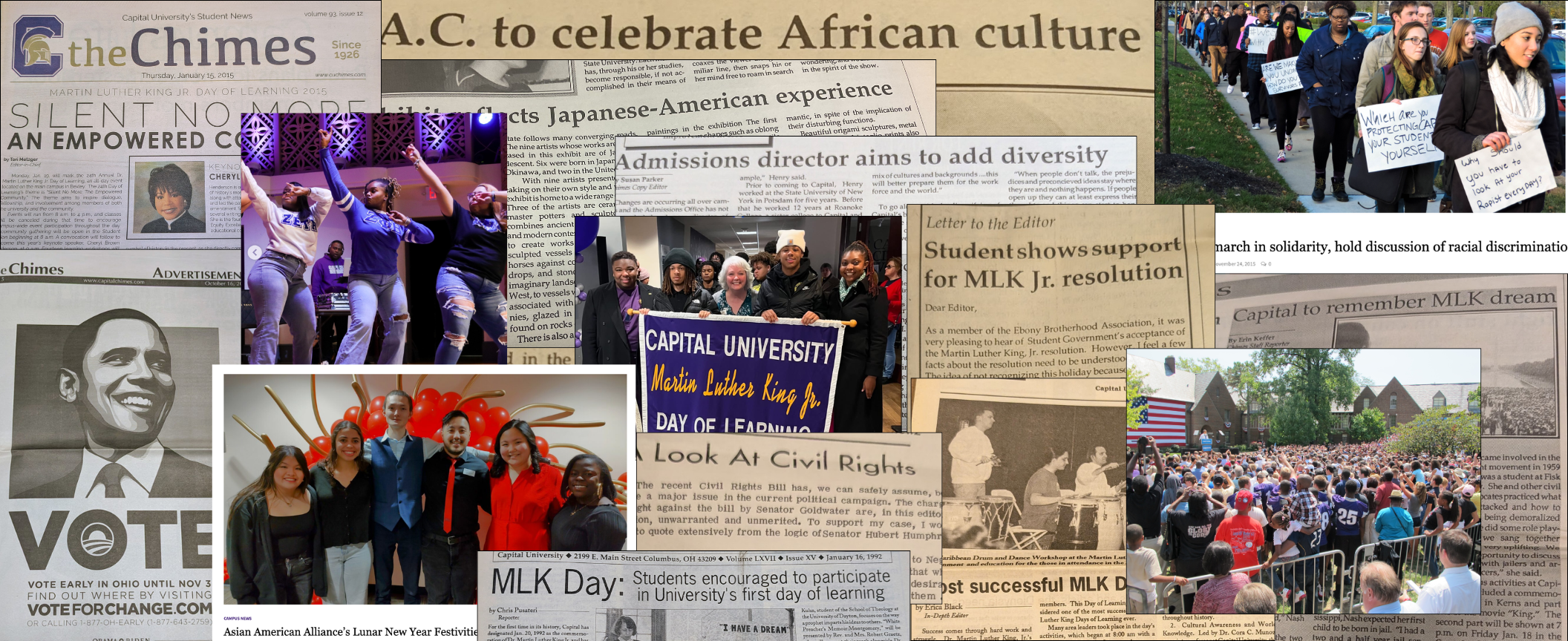
With the 100th anniversary of the Chimes and the historically-significant month of Black History, the Chimes highlights the struggles of racial diversity as seen in past articles.
Racial diversity in the United States has been an extremely sensitive topic for many years due to the brutal history white Americans have shown their ethnic neighbors.
Instead of focusing on the history of xenophobia, the Chimes decided to honor and spotlight the courageous events and experiences of those of different races, fighting for their deserved diversity and inclusion.
Starting with 1964, David Hockenbery, assistant manager of the Chimes, wrote an opinion piece highlighting the passage of the famous Civil Rights Act and his issues among the charges against said bill.
“The recent Civil Rights Bill [of 1964] has, we can safely assume, become a major issue in the current political campaign,” Hockenbery said. “The charges brought against the bill by Senator Bill Goldwater, are, in this editor’s opinion, unwarranted and unmerited.” Goldwater was the opposing nominee in the 1964 race against Lyndon B. Johnson.
The New York Times released an article titled: “Humphrey Charges That Goldwater Is Conducting a ‘War on Progress,’” emphasizing the victory of the passing of the Bill.
Humphrey was asked about Goldwater’s “risk on the evolution of Civil Rights.”
He replied: “[Goldwater] isn’t for [the bill]; he denounced it as a police state, which, of course, it is not … I hope no one attempts to play politics with civil rights.” Humphrey also said he was “proud” of the act. Later in the year, Johnson won by a historic 61% to 39% landslide.
Transitioning to the 1990s, the university began to take a more prominent role in emphasizing the representation of other races.
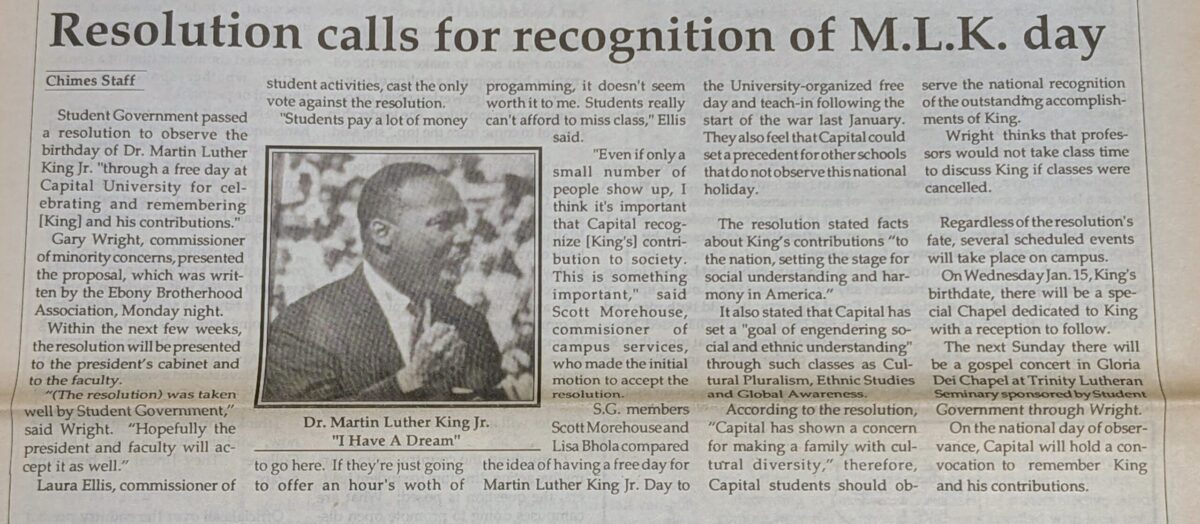
The famous 1990 Martin Luther King commemoration, spoken by the ceremony’s first keynote speaker, Gay Steele, set the stage on how we see the “Martin Luther King Jr. Day of Learning” today.
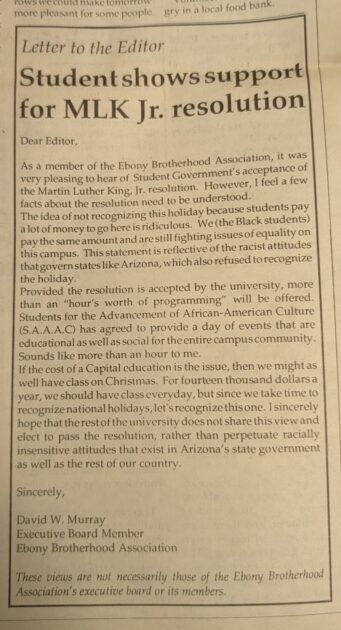
A couple years later, thanks in part to the work of David Murray, then-president of the Ebony Brotherhood Association, “Martin Luther King Day” officially became a “day of learning” for the university.
Murray exclaimed the hospitality of these different backgrounds: “We need to learn how to deal with the diversities of other cultures.”
The issues of racial inequality and discrimination are not exclusive to the United States. In the 1990s, students across the world protested apartheid (an all encompassing legal system that enforced a racial hierarchy) in South Africa.
Only a few months later, following the release of Nelson Mandela, the Chimes covered a story following Dartmouth College and their total divestment of business assets in South Africa.
An article by the Chimes titled “Dartmouth College, First Campus to Protest Apartheid,” highlighted that on Nov. 13, 1993, Dartmouth College was “the first college that year to fully detest and cease investments in South Africa.”
“This has been an evolutionary process,” said former college spokesman Alex Huppe. After this event, Georgetown University, the University of Alabama and Oberlin College ceased investment.
The Schumacher Gallery historically has been a place where students and citizens alike can view some of the most creative pieces of art our students have to offer, but on Aug. 26, 1990, they decided to take it one step further.
“The Sakura in Buckeye County: Japanese Artists in Ohio,” an Asian-American exhibit, was opened for commemoration of their traumatic history within the U.S. and the cultural heritage of the Japanese in Ohio.
Simultaneously, the exhibition served as a memorial for the Japanese imprisoned in internment camps during World War II.
“Finally, there are a large series of photos which portray the American correctional system and other institutions that deal with confinement, detainment, control and loss of individual freedom,” said former Chimes writer Rob Damron in the 1990 article “Exhibit reflects Japanese American Experience.”
“The photos contrast the grotesque and beautiful. Ironically, the color in the photographs make the subject matter so romantic, in spite of the implication of their disturbing functions.”
