

Last spring, the university’s Board of Trustees launched “Capital Rising,” a five-year university-wide strategic plan that will carry the university through its bicentennial in 2030.
“[Capital Rising is] designed for us to think as a university about how we continue to create dynamic student experiences, innovative and responsive academic programs, inviting campus spaces and places … It allows us to better tell our story, build our reputation, raise resources, engage our alumni and strengthen our foundations into our third century,” said President Jared Tice.
The strategic plan is accessible for anyone to view online.
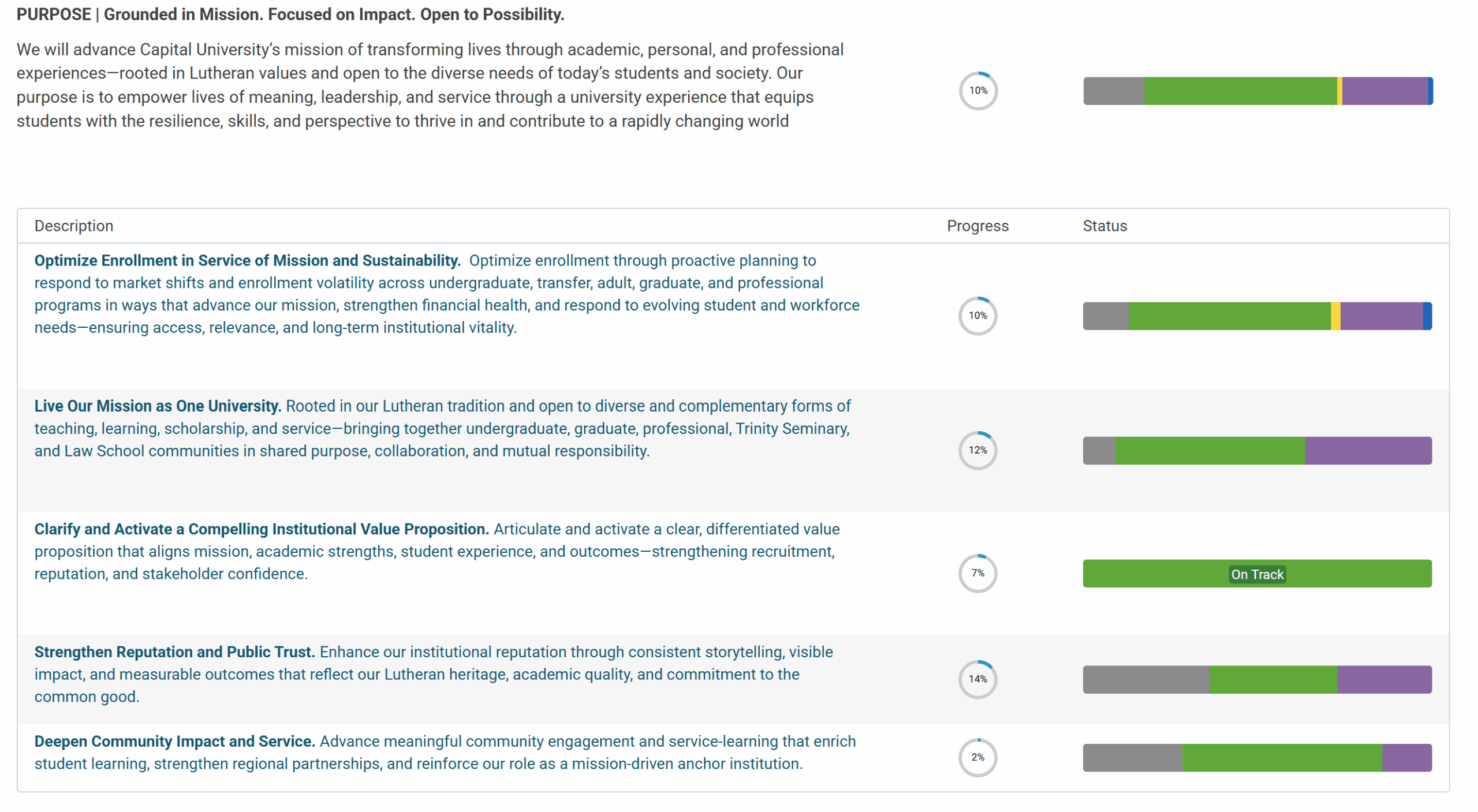
Capital Rising is divided into five pillars: purpose, people, pursuits, place and resources. Each pillar is accompanied by four to five goals, and each goal is divided into initiatives. The plan includes 163 current initiatives. They are then divided into tasks.
“This is the most comprehensive strategic plan I’ve seen us create … One of the central tenets of the plan is that we are one university, and we haven’t always operated like one university,” said Provost Keirsten Moore, who has been at the university for thirty-two years.
“In the past, strategic plans have taken place and kind of been ruled out, then put on a shelf, and nothing ever went anywhere. Under Dr. Tice’s leadership, we are seeing things happen,” said Lisa Diem, assistant dean and chief operations officer at the law school. She is also a co-chair of Capital Rising.
Progress is already occurring in some areas of the plan.
“Students are going to see immediate indirect impacts of Capital Rising,” said Tice, “I do think they’re going to live Capital Rising and not just … see it after they graduate.”
The dashboard labels the status of goals and initiatives using percentages and color coding. The labels are “status pending,” “on track,” “some disruption,” “upcoming” and “completed.”
The percentage of completion correlates to the number of tasks that administration has checked off under each initiative and goal.
“If I have ten tasks associated with [an] initiative, each one makes up ten percent … Some [initiatives] may have five [tasks], some may have twenty, some just maybe one singular task in which you can quickly get to a hundred percent,” said Breidenbach.
Limited resources can cause an initiative to be labelled as facing “some disruption.”

“[A] challenge you’re going to have in any strategic plan, no matter what, is always going to be resources … especially … financial resources… Especially in the current day that we live in, where certain things all of a sudden cost more than what you initially thought,” said Justin Breidenbach, dean of the School of Management and Leadership and co-chair of Capital Rising.
“That’s where it may move the needle a little bit on something you had prioritized, and maybe you start to say, hey, the cost of this now is going to maybe start to outweigh the benefit and maybe we want to pause that initiative,” Breidenbach continued.
Funding for the strategic plan depends on a mix of reallocating funds in the existing university budget, applying for new grants and receiving donations.
“The other [question] then too, is for some of these … bigger initiatives, is does it need a new funding stream? And that can come in a lot of different ways. It doesn’t always mean … as a student that you’re going to see an increase in tuition,” said Breidenbach, “But what we’re really talking about is are there opportunities to go out and find grants? Are there some funding sources out there that have been untapped that we might now be able to go towards? Is it a situation where maybe we have donors who are very interested in a project?”
Departments may consider “sunsetting” certain programs to make room for new initiatives.
“A big part that came through this process was to figure out if there’s anything that we need to reallocate. Is there something you should sunset? Is there something that should end? [Something] that you’ve been doing for a while, it had great impact a long time ago, but it just hasn’t been having the same impact now … Maybe it’s just time … to take those resources and shift it to something else that would then have a bigger impact?” Breidenbach continued.
“As president, we haven’t sunset anything that I would consider major … Though departments have the ability to sunset initiatives or programs that they think are no longer viable … We’d rather students be engaging in the new thing that they want to be doing instead,” said Tice.
Tice welcomes students with interest in any initiative to reach out to the office of the president.
