
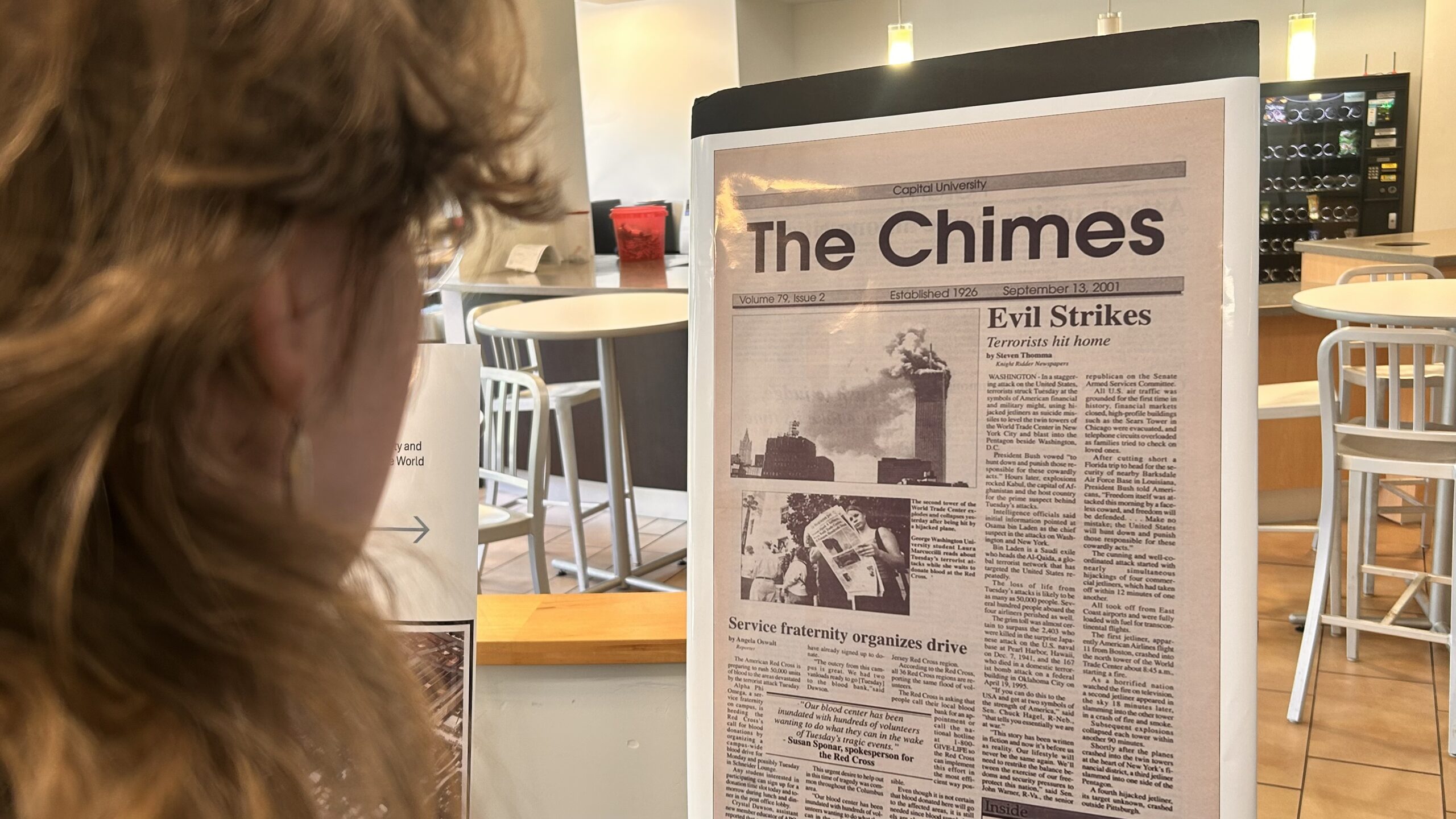
Twenty-five years after the Sept. 11 terrorist attacks, archived articles give insight into the university’s response and how these conversations are still relevant today.
As students who were not yet born when terrorists attacked the World Trade Center, it is easy to feel distanced from this event; however, on the university’s campus, the memory and effect of that morning have never been forgotten.
An archived copy of the Chimes from Sept. 13, 2001 offers a glimpse into campus life immediately following the attacks. Though it is a record of what happened nationally, it also realistically documents how members of the Bexley community were feeling after such a catastrophic event.
The front page reported on a campus-wide blood drive hosted by Alpha Phi Omega in response to the attacks. More than 150 university students had already signed up to donate at the time of the article’s publication.
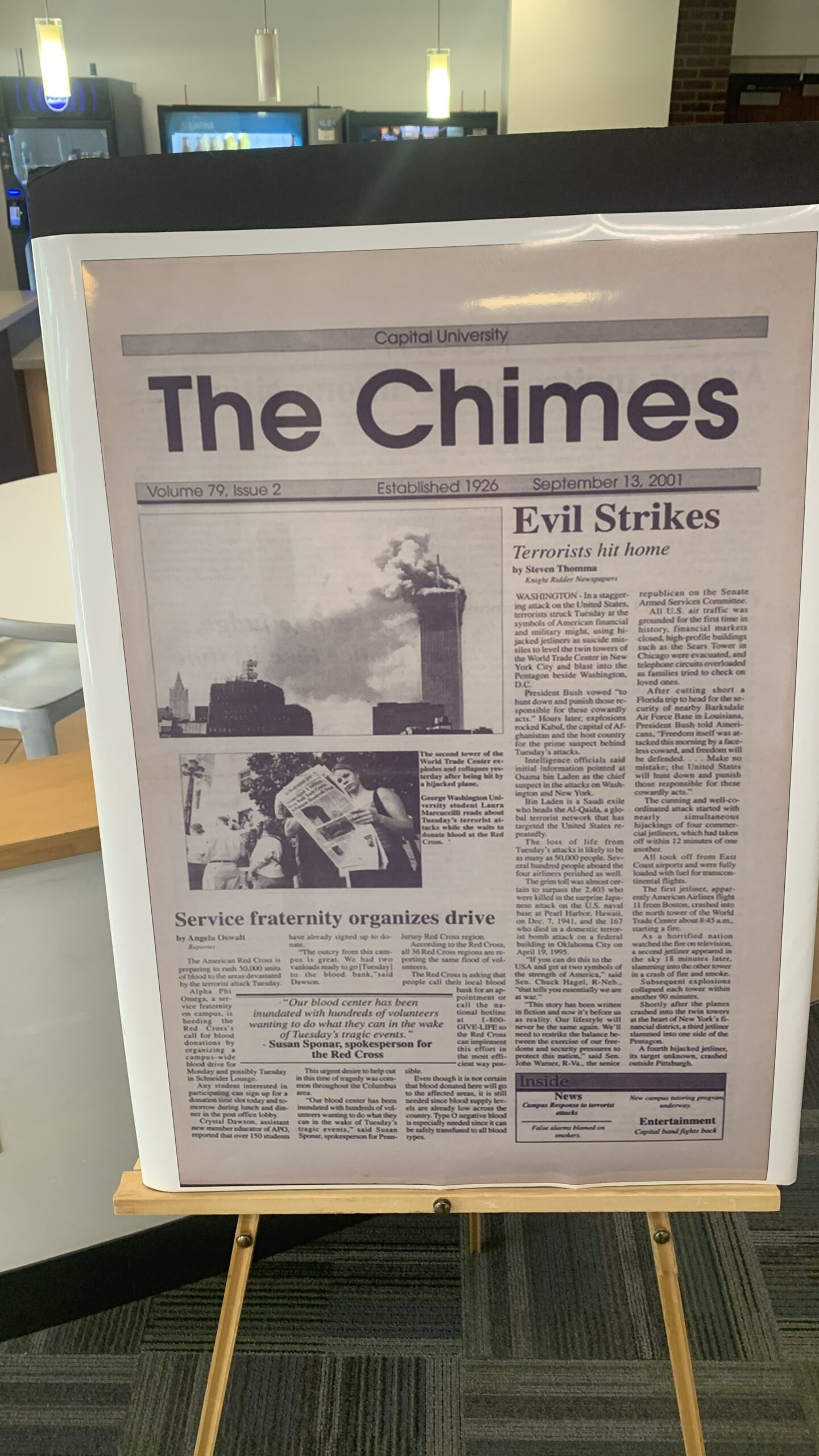
“Our blood center has been inundated with hundreds of volunteers wanting to do what they can in the wake of Tuesday’s tragic events,” said Susan Sponar, a spokesperson for the Red Cross.
A letter published in the same issue of the Chimes described students and faculty gathering in Mees Hall after the attacks. The gathering provided a space for members of the community to share their fears, hopes and grief during the uncertain time.
Andrew Carlson, Ph.D., the chair of the history and philosophy department, was on campus during the attacks and remembers how quickly the events became personal for members of the community.
“One person’s mother was in one of the twin towers. [She] made it out, but it felt close. It felt close,” Carlson said.
The community response is striking because people express both concerns for the future and concerns for the systemic issues highlighted by the tragedy.
A forum piece published in the issue described the atmosphere in Columbus as “tense” and “frightened,” with people rushing to gas stations and reacting defensively as false information and uncertainty grew. At the same time, the writer warned against allowing fear to become prejudice, emphasizing that the actions of terrorists should not be used to condemn Muslims, people from the Middle East, or entire nations.
Another community member made an appeal in a letter to the editor, explaining that his brother-in-law, who is from Turkey, had received suspicious looks because of his appearance. The writer urged the community not to rush to judgment just because the country is searching for someone to blame.
These concerns were reflected in the reaction of the university’s international community as well.
“We had close to 100 international students, many of them from the Middle East, and they immediately left,” Carlson said.
Looking back, these concerns echo issues that we continue to experience today: national security, government intervention and response, immigration, religious and ethnic prejudice, and America’s role in the world.
Carlson, who was in an administrative meeting in the basement of the Kerns Religious Life Center when he first heard that a plane had hit the World Trade Center, acknowledges that the event was a serious turning point in how he viewed America.
“I felt like the 9/11 moment was very big because people that I read, like Jeffrey Sachs, [author of] ‘The End of Poverty,’ had this call for Americans to make the world a better place and to show that America wasn’t the great Satan,” Carlson said.
His reflection on the attacks has continued into the classroom, where he discusses Sept. 11 in his Cultural Pluralism courses. For him, revisiting the event also means considering what the country’s response says about America today.
“I think that 9/11 brings us back to fundamental questions about what it is that makes America a virtuous and good country, and what are our failings,” Carlson said.
At the university, those questions continue to be explored through its ongoing remembrance of Sept. 11.
Last Friday, the anniversary of the attacks, a remembrance ceremony was held at the Reflection Fountains. Students gathered at 8:30 a.m., nearly the same time that flight attendants on Flight 11 alerted ground personnel of a potential hijacking in 2001.
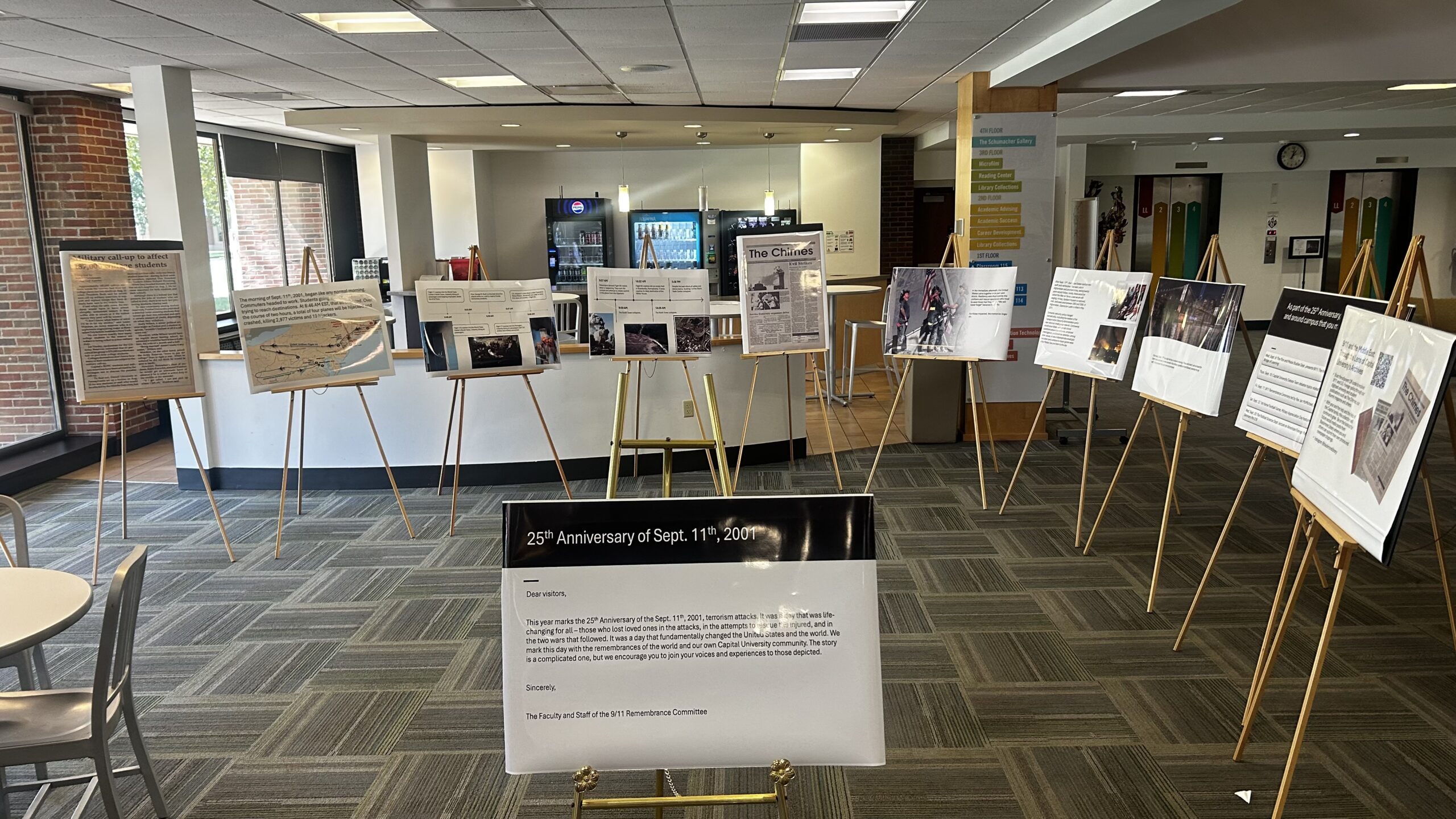
The event has also been memorialized in other ways throughout campus. Blackmore Library displayed related artwork, as well as the archived article from the Chimes. Later this month, the political science department will continue the conversation with a lecture examining how American foreign policy has changed since the attacks.
For students who were not alive in 2001, the archive provides a way to understand Sept. 11 as more than a national tragedy. It helps to put into perspective the real people affected and the communities from across the country that did what they could to aid in a time of crisis. The pages of the Chimes preserve that history while the university’s continued remembrance gives current students an opportunity to consider what has changed, what has remained and what can be learned.
