
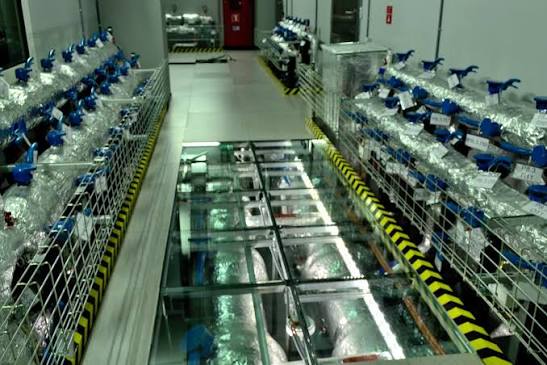
The Ohio Environmental Council held a meeting in the Bexley Public Library earlier this month to inform residents of the industry plans to implement Hyperscale Data Centers into Central Ohio.
Data centers are already common in the state of Ohio, and what brings concern to communities is the environmental and financial instability they currently cause, as well as the progressing plans to construct wider facilities, likely resulting in a larger effect on the state’s resources.
The Ohio Environmental Council (OEC) is a statewide advocacy organization that focuses on protecting the health and environments of all communities. Annalisa Roca, the central Ohio regional director of the OEC, highlighted the energy demand, water consumption and economic costs of the already established facilities and how the coming of hyperscale facilities will add on to the existing factors.
Ohioans are actually paying for the costs of data centers through their electric bills due to the state’s grid capacity skyrocketing. “Grid capacity is the cost of electricity being demanded on a regional grid,” said Roca. Our state’s regional grid is PJM Interconnection, which consists of Ohio, Illinois, Kentucky, etc. 63% of the increase in costs per megawatt of energy a day are driven by data centers, according to PJM’s independent market.
Hyperscale data centers can consume as much electricity from 75,000 to 100,000 homes on a daily basis.
American Electric Power’s Ohio customers first saw the increase to their bills in summer of 2025 from $28.92 to $269.92. In 2026, the energy cost increased by $329.17. Data centers are set up to consume 11% of Ohio’s total electricity by 2030. “This increase in demand is reflected in a lot of huge natural gas plants that are being built,” said Roca.
In Piketon County, a gas plant is being built, which is set to require 9.2 gigawatts of energy. Gas plants like the one being planned for Piketon are also being placed in neighborhoods around the state.
In the city of Hilliard, Amazon built data centers next to a neighborhood without communicating with the city council. Amazon went to the Ohio Power Siting Board and Environmental Protection Agency (EPA) to have a natural gas plant implemented to generate energy for the facility. The city’s residents did not have much chance to voice their concerns.
According to Roca, people who live in the neighborhood next to the gas plant hear “a constant hum” and are worried about the air quality being affected by the gas plant.
One hyperscale data center can consume up to 5,000,000 gallons of water per day. Most facilities use an open-loop vapor cooling system to evaporate 70% of the water consumed. There are also concerns about the use of different chemical additives used in the cooling process.
Roca also stated that “only one in three data centers track their water use, and even those that do track their water use either choose not to release it to the public or will cite that it’s proprietary information and therefore cannot report and release due to competitors in the industry.”
“Farmers are worried about whether or not there will be enough water left for them after the data centers,” Roca said.
The OEC also fought against a now rescinded EPA draft that would’ve granted data centers a permit to discharge their water with no PFAS regulation, despite its exposure to chemical additives. PFAS refers to chemicals that are broken down and released into the environment. The permit is still available on a case-by-case basis.
Sales tax exemptions for data centers also resulted in major loss of revenue for the state. By late 2025, $1.56 billion was lost. Gov. Mike DeWine recently paused the tax breaks for new proposals. The money that was lost could have been used to fund the Ohio EPA for 119 years and funded public schools in Bexley.
In some reported cases, nondisclosure agreements have been used to prevent local officials and the public from learning about planned developments. The Ohio EPA confirmed that a 1,300 megawatt facility was built in Adams County and the local community only learned about it through a public records request.
There is a large policy gap in Ohio. There are no state requirements for reporting water, no statewide NDA protections and no decommissioning requirements.
Around April–May 2026, before the Statehouse went into recess, they were working on House Bill 646, which is the first step in regulating the massive growth in data centers. This bill can ensure that data centers pay directly for their electricity use instead of Ohioans and that the facilities will have to measure and publicly report the amount of water they use and what they discharge. The bill would cut tax exemption in half, securing a mass amount of money in tax income from the facilities.
“We need action now, from our local and state leaders on this issue and we also need you to help us in that fight,” Roca said.
Roca encouraged Bexley residents to contact their local elected officials and voice their concerns and opinions on the data center issue and how it should be handled.
Roca recommended to students of the university to join organizations associated with the OEC, including Emerging Leaders, a youth advocacy organization that gives opportunities for students to directly take action for local causes.
Roca said Columbus is one of the few cities talking about decommissioning plans and requirements. “The city council also encourages feedback from Bexley and other towns connected to Columbus,” as they understand their decisions also affect said towns.
The video displaying the full meeting and presentation can be found here.
